The Packaging and Packaging Waste Regulation, or PPWR, is changing how European companies approach industrial packaging. Recyclability remains important, but businesses must also look at packaging prevention, reuse and material efficiency. For plastics processors, compounders, extruders and injection moulders, this raises a practical question: how can the number of Super Sacks used per tonne of material be reduced without compromising safety, quality or production continuity?
The first step is to understand the current process. How often is each Super Sack reused? Why is it eventually rejected? At which point does damage occur, and how much material is lost through spills or incomplete emptying? A reusable Supe rSack only creates real environmental value when it completes enough rotations in practice.
Extending the life of Super Sacks
During conventional handling, forces can become concentrated on the lifting loops and specific areas of the fabric. Deformation, unsupported storage and repeated lifting can therefore shorten the useful life of the bag. The NEVA Super Sack Carrier supports the Super Sack during storage, internal transport and unloading. This reduces pressure on the loops and the bag itself, while creating a more stable and controlled handling process. The system is suitable for materials such as pellets, granules, flakes, powders, resins and additives.
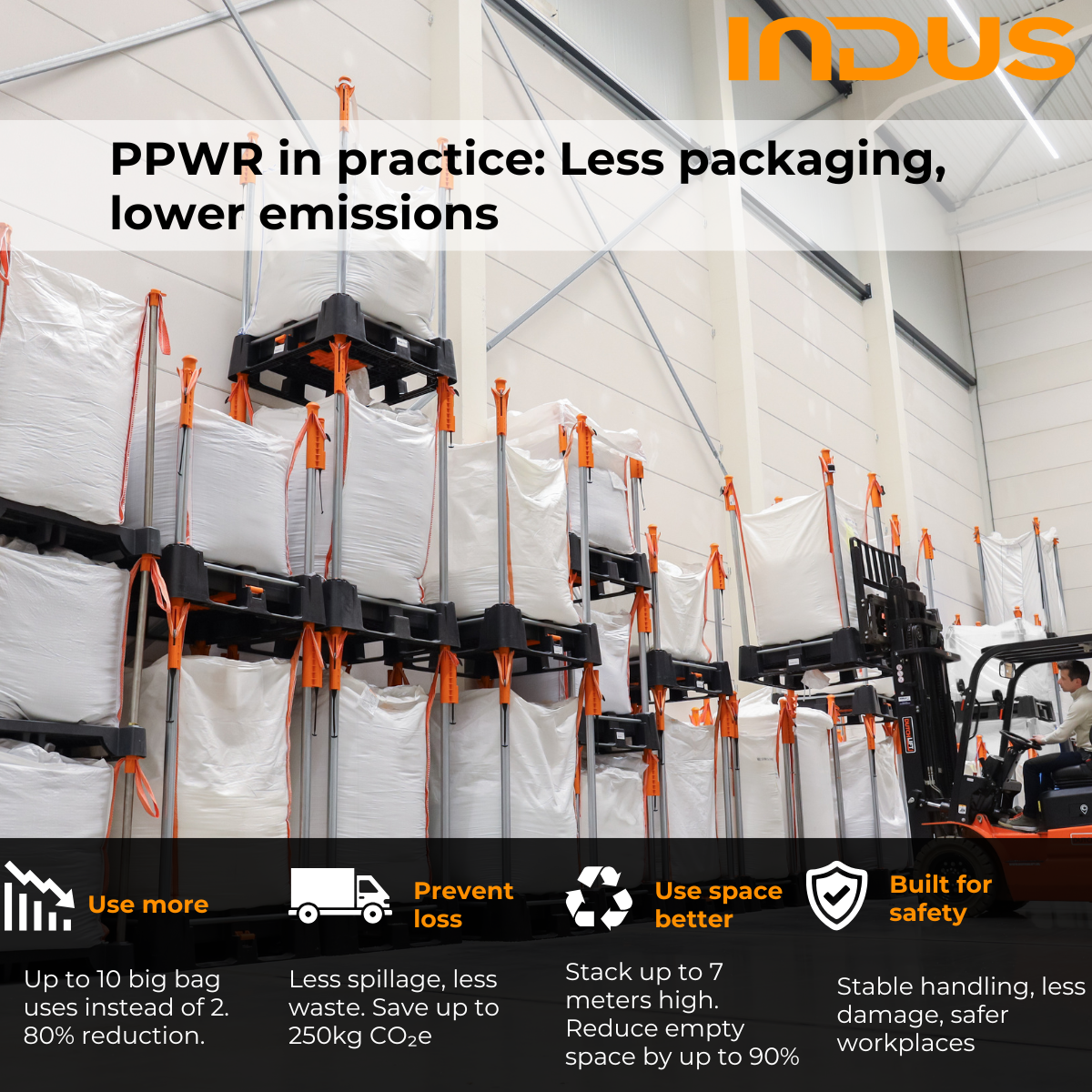
Based on Indus’ operational findings, a Super Sack that would normally complete around two rotations can, under suitable conditions, be used up to ten times.
For every 1,000 filling and unloading cycles, this would reduce consumption from 500 Super Sacks to 100. That means 400 fewer Super Sacks = 80% reduction in packaging use. Actual results will depend on the type of Super Sack, its safety specification, the material handled, hygiene requirements and the inspection procedure.
Preventing product loss
Better support can also reduce the risk of damage, instability and spills. This matters because the environmental impact of the lost granulate, compound or additive may be significantly greater than that of the Super Sack itself. A spill may result in lost material, cleaning work, waste treatment, downtime and a replacement delivery.
Companies can estimate this impact using a simple calculation: Avoided emissions = avoided product loss × product carbon footprint.
Preventing the loss of 220 lb of black mass with a carbon footprint of 1.13 lb CO₂e per pound can avoid approximately 551 lb CO₂e emissions, excluding emissions from cleanup and replacement transportation.
The related EU Regulation 2025/2365 on preventing plastic pellet losses further increases the focus on controlled handling throughout the plastics supply chain. It introduces obligations aimed at preventing pellets from escaping into the environment. We will explore this regulation and its operational implications in a separate article.
Using storage and transport space more efficiently
The NEVA Super Sack system can also improve space utilisation. Filled systems can be stacked vertically, while empty systems can be dismantled for compact storage. Depending on the configuration, NEVA systems can be stacked up to 23 ft high, and require up to 90% less space when dismantled. This can reduce internal movements, the need for external storage and unnecessary material transfers.
Empty bulk handling systems can also be returned more efficiently. The actual emissions benefit should be calculated using the company’s own transport distances, load factors and energy consumption.
How does the PPWR apply to NEVA?
In its normal production application, Indus and its PPWR Advisors among which Verpact, currently considers NEVA to be durable handling or process equipment rather than packaging. However, classification under the PPWR depends on the actual function of an item.
When a NEVA system circulates between a supplier and customer and supports, stabilises or protects goods during transport, that particular application may need to be assessed as transport packaging.
Where it qualifies as packaging, requirements may include technical documentation, substance information, recyclability, conformity assessment and an EU declaration of conformity.
Better packaging starts with better handling
The PPWR encourages companies to look beyond the packaging itself and assess the complete handling process. For Super Sacks, successful reuse depends on how they are filled, supported, stored, transported, emptied, inspected and returned. By reducing mechanical damage, preventing product loss and improving logistics, better handling can turn theoretical reusability into measurable packaging reduction.
For European plastics processors, this is not only a compliance issue. It is also an opportunity to reduce material use, emissions and operational risk.