Why Is Safe Black Mass Handling Critical in Battery Recycling?
As the electrification of transport and industry accelerates across Europe, the demand for battery recycling capacity continues to grow. Through the EU Battery Regulation, Europe aims to recover and reuse critical raw materials such as lithium, nickel, cobalt, manganese and graphite, reducing dependence on imported resources and strengthening a circular economy.
In a modern battery recycling facility, end-of-life EV batteries are dismantled, shredded and separated into valuable material streams, which are often packed in big bags for safe transport and storage. One of the most important outputs is black mass: a fine powder containing valuable battery materials. Due to its high value and potential health risks, black mass handling requires safe, controlled and dust-free material handling.
How Can You Optimize Black Mass Handling in Super Sacks?
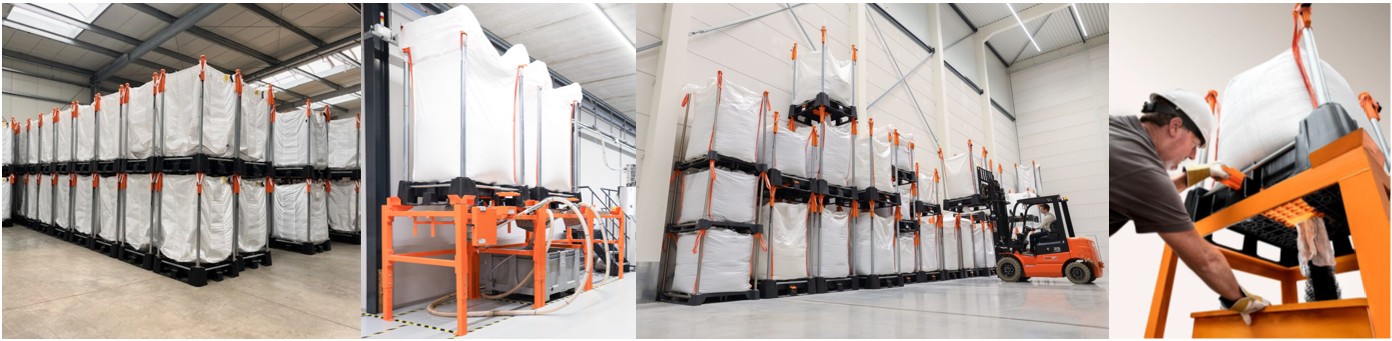
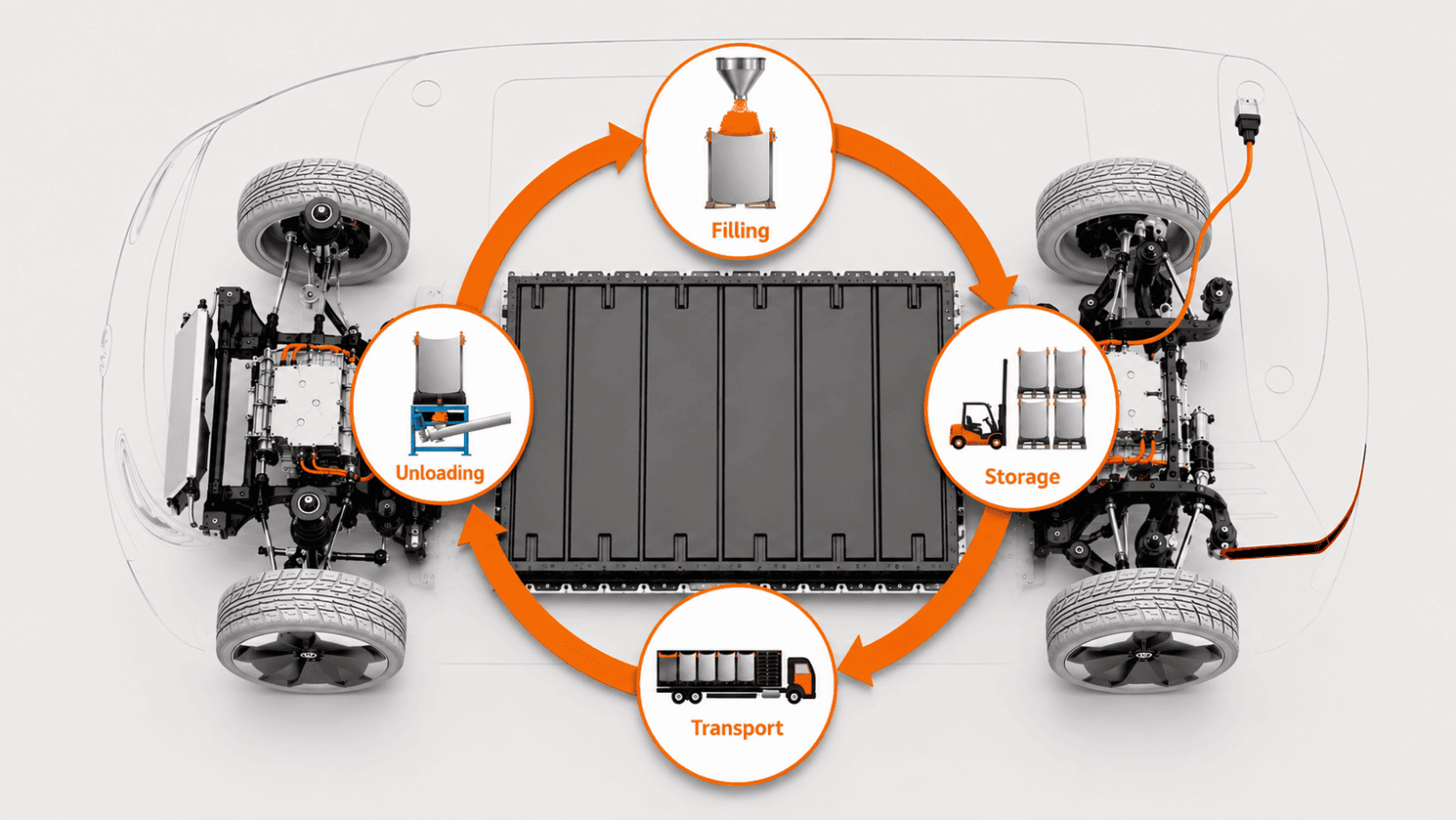
The NEVA Super Sack Handling System optimizes battery material handling throughout super sack filling, transport, storage, safe stacking and super sack unloading. The Super Sacks remains on the same carrier during the entire process, eliminating unnecessary lifting and transfer operations. This reduces the risk of damaging the bag, minimizes operator exposure to dust and improves safe battery handling.
The NEVA Super Sack Pallet stabilizes the Super Sack throughout the complete logistics chain, including internal handling, warehouse storage and external truck transport. After unloading, the support poles can be removed from the pallet and stacked compactly, reducing return transport volume and lowering logistics costs.
Indus Super Sack unloading stations are modular and can be configured for different battery recycling processes, with a strong focus on low-dust unloading, minimizing product loss, dust emissions and cross-contamination while improving process safety. Because the same Super Sack can be reused multiple times within the NEVA system, companies also support the sustainability objectives of the new Packaging and Packaging Waste Regulation (PPWR).
For EV battery recycling companies, where a single Super Sack of black mass can represent a value of $5,700–$13,700, protecting both operators and valuable materials is essential. By combining Super Sack handling, battery powder handling, black mass transport and bulk bag unloading in one integrated solution, the NEVA system supports a safer, more efficient and future-proof battery recycling process.