At Indus Bulk Logistics, we look at how companies can make the handling of bulk materials in big bags future-proof. This means improving safety and efficiency, but also understanding how developments such as the Packaging and Packaging Waste Regulation (PPWR) and the EU Plastic Pellet Loss Regulation affect material-handling processes.
From 17 December 2027, Regulation (EU) 2025/2365 introduces requirements to prevent plastic pellet losses across the EU supply chain.
For plastics factories, this is about more than cleaning up spills. The regulation follows a clear hierarchy: prevent losses first, contain them when they occur and clean them up as a final step.
The way pellets are stored, transported and unloaded therefore becomes an important part of preparing for the regulation.
Does the EU Plastic Pellet Loss Regulation Apply to Your Factory?
For economic operators, the regulation applies when 5 tonnes or more of plastic pellets were handled in the EU during the previous calendar year.
Plastic pellets are defined in the regulation as polymer-containing material, regardless of shape, form or size, produced for moulding in plastic product manufacturing operations.
This means the 5-tonne threshold determines whether the regulation applies, while the 1,500-tonne threshold per installation introduces additional requirements, including certification for certain enterprise sizes.
From 5 tonnes per year
| Enterprise size | Requirement | Applies from |
| Large (not an SME under the EU definition) | Regulation applies: risk plan, prevention measures, training and records | 17 December 2027 |
| Medium (<250 employees; ≤€50m turnover or ≤€43m balance sheet) | Regulation applies: risk plan, prevention measures, training and records | 17 December 2027 |
| Small (<50 employees; ≤€10m turnover or balance sheet) | Regulation applies: risk plan, prevention measures, training and records | 17 December 2027 |
From 1,500 tonnes per year per installation
| Enterprise size | Requirement | Certification date |
| Large (not an SME under the EU definition) | Mandatory certification | 17 December 2027 |
| Medium (<250 employees; ≤€50m turnover or ≤€43m balance sheet) | Mandatory certification | 17 December 2028 |
| Small (<50 employees; ≤€10m turnover or balance sheet) | Mandatory certification | 17 December 2030 |
Microenterprises follow a simplified compliance route and are not included in the tables above.
Where Do Plastic Pellet Losses Occur?
Pellet losses often result from small weaknesses repeated throughout everyday material handling.
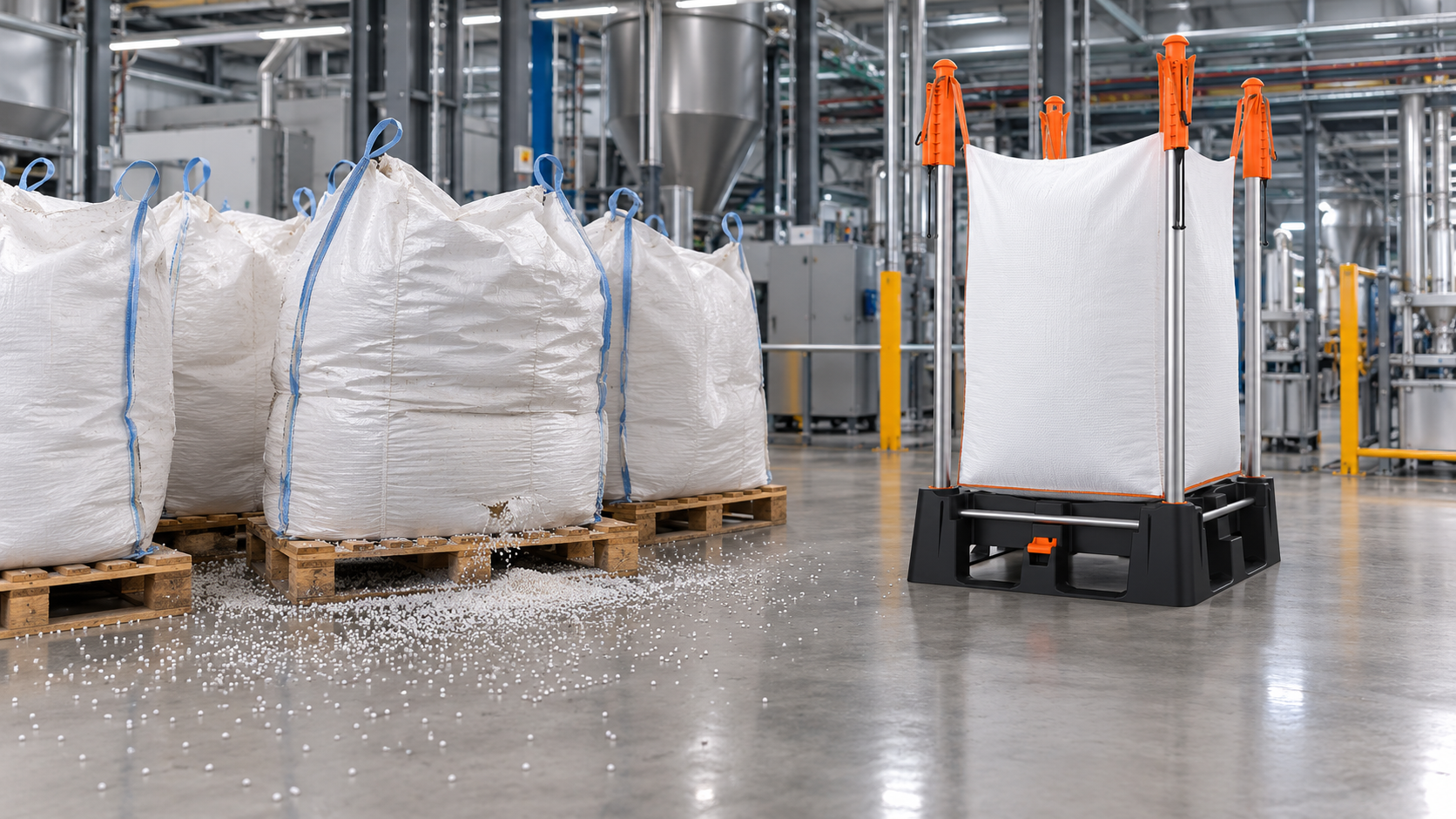
A big bag can be punctured by forklift tines, become unstable during transport or release pellets while being connected to production equipment. Residual material can also spill when an empty bag is removed.
Every additional lift, repacking step or transfer introduces another point where the bag can be damaged or pellets can escape.
Reducing unnecessary handling and transfer points is therefore a practical way to reduce pellet loss risk.
Fewer Transfer Points from Storage to Production
The NEVA Big Bag Carrier is designed to keep the big bag supported throughout the internal logistics process.
Instead of transferring an unsupported bag between separate pallets, storage frames and unloading systems, the same NEVA carrier can be used for filling, storage, internal transport and unloading.
The big bag rests on a stable deck while the poles support the lifting loops. This helps protect the bag against deformation and handling damage while creating a consistent process from warehouse to production.
The principle is simple: fewer transfers mean fewer handling moments where bag damage or pellet spills can occur.
For a pellet loss risk management plan, preventing these risks at the source is more effective than relying on clean-up after a spill has already occurred.
Controlled Big Bag Unloading
Unloading is another important point where pellet losses can occur.
With the NEVA Big Bag Unloading Station, the complete carrier is positioned above the production process using a forklift. The big bag remains supported while the material is discharged through the opening in the deck.
Depending on the material and process, the station can be combined with enclosed transfer, vacuum conveying, dosing, vibration or bag activation.
This creates a more controlled connection between the big bag and production equipment and can help reduce manual intervention, residual material and uncontrolled discharge.
How NEVA Can Support Your Pellet Loss Plan
No individual product makes a factory automatically compliant with Regulation (EU) 2025/2365. Compliance also depends on procedures, training, maintenance, documentation and the complete site layout.
However, NEVA can support several objectives behind the regulation by protecting big bags during storage and movement, reducing unnecessary transfer points and creating a controlled unloading process.
The same future-proof approach is relevant to packaging legislation. Read more about the relationship between reusable big bags and the PPWR in our article about big bag reuse.
Is Your Factory Ready for 2027?
When reviewing your pellet handling process, start with five practical questions:
- Where can pellets escape during storage, transport or unloading?
- How many times is a big bag transferred before reaching production?
- Are bags sufficiently protected against damage and instability?
- Is the connection between the big bag and production equipment controlled?
- Can you demonstrate how your equipment and procedures help prevent pellet losses?
The 2027 deadline means companies now have the opportunity to identify risks, test improvements and incorporate them into their working procedures and risk management plans.
Prepare Your Big Bag Handling Process
Indus helps plastics manufacturers develop a safer, more controlled and future-proof process for bulk materials in big bags.
Based on your material, big bag dimensions, volumes and factory layout, we can evaluate how storage, internal transport and unloading can be combined into one integrated process.
Would you like to identify the pellet loss risks in your current big bag handling process? Contact Indus Bulk Logistics.